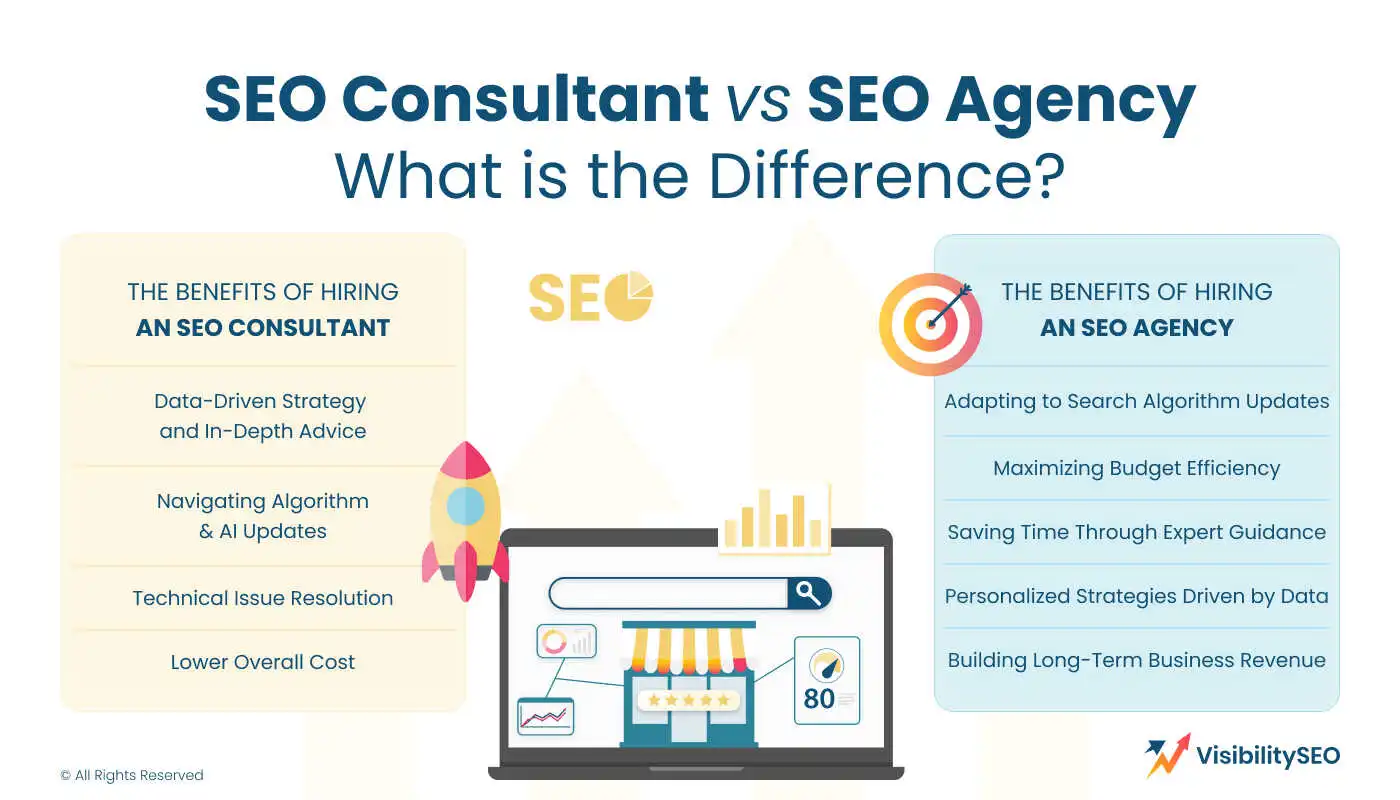
Most companies don’t start by asking this question – they usually arrive at this crossroads after something feels stuck. Traffic is okay, but leads are scarce. Maybe rankings have plummeted. Or the marketing team’s always talking about SEO, but nobody has time to really get on top of it. At that point, the choice is pretty straightforward: hire an SEO consultant, go with an SEO agency, or try to build an in-house team from scratch.
An SEO consultant and an SEO agency can both lend a hand, but they’re not the same kind of SEO partner. When it comes to SEO Consultant vs SEO Agency, the right choice depends on your business goals, budget, internal resources, and how much SEO work needs doing each month.
What is an SEO Consultant?
An SEO consultant is usually an independent specialist who helps a business understand what is blocking organic growth. Some work alone as freelance SEO consultants and some operate as a boutique SEO consultancy. Their work often includes an SEO audit, technical SEO review, competitor research, keyword planning, content advice, and wider SEO strategy.
The main value is judgment. A consultant provides the strategy, but also explains why the strategy makes sense. That is useful when a business already has writers, developers, or an in-house team, but needs stronger SEO thinking. In simple terms, the consultant gives direction so the team does not waste time fixing the wrong things.
What is an SEO Agency?
An SEO agency is a company that delivers SEO services through a team of people. That team might include a strategist, an account manager, technical SEO service specialists, writers, link building staff, digital PR support, and reporting specialists.
A full-service SEO agency can usually handle way more complicated work than one person could manage on their own.
This model suits businesses that need regular delivery, rather than just advice. For example, an agency can run an SEO audit, plan some content, produce a few pieces of content per month, build some links, review any technical issues, and report on how things are going.
It also comes with more process and usually a higher retainer, which can be a blessing or a curse depending on your situation.
SEO Consultant vs Agency: Selecting the Right SEO Partner for Your Business
The choice between an SEO consultant and an SEO agency is really a choice between advice and delivery. Of course, there is overlap. Some consultants implement. Some agencies give excellent strategic advice. But the usual difference is still clear enough.
If you’ve got an in-house team that can write, edit, publish and fix technical issues, a consultant may be the way to go. If your team is small, busy or missing key skills, an agency may be a safer bet.
The right answer ultimately depends on the size of your business, your budget, the skills within the company, and how much SEO work needs doing every month.
The Benefits of Hiring an SEO Consultant
Hiring a consultant can be a practical move when you want direct access to senior SEO thinking. There are fewer layers. You are not waiting for an account manager to ask someone else and come back with a half-answer. In many cases, the person you speak to is the person reviewing your site.
This model works well for founders, marketing managers and in-house teams that need some guidance. A consultant can help you make an informed decision before you commit to a bigger retainer. They can also challenge any weak ideas, find any problems you may have missed, and give you honest feedback on whether your current SEO work is actually going to deliver results.
Data-Driven Strategy and In-Depth Advice
A good consultant will start by reviewing all the evidence: rankings, organic traffic, conversions, competitor pages, technical issues, content gaps, and backlink quality. Then they’ll turn those findings into an SEO strategy that your team can actually use.
This is where a consultant can really add some value. A site might not need “more content” in general – it might need better category pages, stronger internal links, cleaner indexation, or fewer weak blog posts. The advice should be specific – and it should connect SEO work to business outcomes, not just charts in a report.
Navigating Algorithm & AI Updates
Search changes can make even good teams second-guess themselves. A Google update lands. AI Overviews appear above the results. Traffic shifts. Someone asks if the whole SEO strategy is broken. Usually, the answer needs more care than that.
A senior SEO consultant can review what changed and where the impact happened. Did rankings drop, or did website clicks drop? Did competitors improve? Did Google answer the query directly? The fix may be content quality, stronger authority, clearer entities, technical cleanup, or better internal linking. Sometimes it is a mix. A consultant helps separate the real issue from the noise.
Technical Issue Resolution
Technical SEO is one of those areas where small problems can create large waste. A site may have strong pages, but poor crawl paths. Or old redirects. Or duplicate pages sitting in the index. Or slow templates that hurt important landing pages.
A consultant can find these issues and turn them into clear tasks for developers. This is especially useful when your business already has developers who can implement changes. The consultant does not need to manage every ticket. They provide oversight, priorities, and quality checks. That can keep costs lower and make the technical work more focused.
Lower Overall Cost
Working with a consultant almost always works out cheaper than hiring an SEO agency. You’re not paying extra for overhead and management layers, and you’re not employing a big team. You’re essentially paying for someone’s senior-level expertise, rather than a big team to deliver the whole thing.
But not all consultants are low cost. You might find a top SEO specialist or strategist who charges big bucks – especially if you’re after a detailed audit or a retainer deal. But if what you’re after is more strategic direction or a bit of expert review, a consultant can often be a more efficient way to get what you need.
The Drawbacks of Hiring an SEO Consultant
A consultant can be the right choice, but only when the rest of the business can support the work. SEO does not move because a document looks good. Someone still needs to update pages, fix the site, create content, build links, and measure the results.
This is where businesses sometimes get stuck. The consultant gives a strong plan. Everyone agrees with it. Then daily work takes over, and the plan sits untouched. Before choosing a consultant or agency, be honest about your internal capacity. Do you have people who can act on the advice? If not, a consultant may not be enough.
Delayed Accountability and Results
A consultant can give you the plan, but in the end, it’s going to be someone else who actually has to get the work done to make it happen: pages need updating, devs need to act on tickets, content needs writing, and links need earning. If none of that happens, then SEO results are going to come to a grinding halt.
It can also get kind of awkward to know who to hold accountable when things don’t move along. Did the consultant mess up, or did the business just fail to implement the advice?
More often than not, it’s somewhere in the middle. So it’s worth setting a clear owner before you even start. If nobody is responsible for actually getting it done, even a great SEO plan can just end up another document stuck in a folder somewhere.
Limited Access to Specialized Expertise
No single consultant is the jack-of-all-trades when it comes to SEO. They might be ace at technical SEO but struggle with PR, or vice versa. That doesn’t make them weak, it just means they’re limited by the fact that one person can only do so much.
This doesn’t mean that consultants are any less valuable than agencies, though. A boutique consultancy might be able to offer a more diverse range of services than a single freelancer, but they still might not have the same depth as a bigger agency. If you’re after a really big, complex SEO challenge that needs multiple people working on it, an agency might start to look like a better bet.
Potential Risks from Poor SEO Practices
Bad SEO can create problems that take months to clean up. Some consultants still rely on weak backlinks, copied content, thin pages, or keyword-heavy writing that no real person wants to read. These things may look active on a report, but they can hurt trust and rankings.
Before you hire a consultant, ask direct questions. How do they approach link building? What does a good piece of content look like to them? What happens after the SEO audit? Can they show case studies or examples? A reliable consultant should explain their process without making it sound mysterious.
Advice Without Execution
A consultant may give the right advice, but your business still has to carry it out. That is fine if you have writers, developers, and someone to manage the work. It is a problem if everyone is already busy.
For example, a consultant may recommend updating 30 old pages, creating 12 new service pages, and fixing a set of technical issues. The plan may be correct. But who writes the pages? Who briefs the developer? Who checks the changes after they go live? If there is no clear answer, you may need an agency or an in-house hire instead.
Time and Availability Constraints
As a freelance consultant, you’ll usually be working with more than one client at a time, which means their time is limited. They might be good for the planned calls and reviews, but you don’t get to call on them for daily help or urgent work.
It’s not a problem for everyone, of course. Some businesses don’t need day-to-day SEO support. They just need a clear plan, a few priorities each month. But other businesses are going to need more hands-on, more urgent, more day-to-day support. And in those cases, you might find that one person just can’t keep up.
The Benefits of Hiring an SEO Agency
An agency makes sense when the business needs more than advice. You may need planning, writing, technical work, digital PR, link building, reporting, and project management all happening at the same time. That is hard for one person to manage well.
An SEO agency gives you a team that can handle strategy and execution. This can be useful for ecommerce sites, national service businesses, SaaS companies, and growing brands with serious search goals. It can also help when the in-house team is small. Instead of building everything internally, you use an outside team to keep SEO moving.
Adapting to Search Algorithm Updates
SEO agencies often work across many sites, so they may notice patterns when search results change. If an update affects several clients in different industries, the agency can compare what happened and look for common causes.
That wider view can help. But it only helps if the agency uses it carefully. Not every traffic drop is an algorithm problem. A good agency checks affected pages, competitors, technical issues, content quality, and search intent before deciding what to do. The best answer is not always dramatic. Sometimes it is simply better pages and cleaner site structure.
Maximizing Budget Efficiency
A good agency should help you spend your SEO budget where it matters most. Some months, that may mean technical SEO. Other months, it may mean content production, link building, or digital PR. The work should follow the data, not a fixed checklist.
This matters because SEO retainers can easily turn into busy work. More tasks do not always mean more progress. A useful agency should be able to explain why a task is being done and how it supports business goals. If they cannot explain the priority, the budget may not be working hard enough.
Saving Time Through Expert Guidance
Working with an SEO agency can save a lot of time inside the business. The agency can create briefs, manage writers, review content, monitor rankings, check technical issues, speak with developers, and prepare reports. That removes work from the founder, marketing manager, or small in-house team.
It also gives the process more structure. There are calls, deadlines, deliverables, and next steps. That may sound basic, but it matters. Many SEO campaigns fail not because the ideas are bad, but because nobody keeps the work moving. An agency can provide that push.
Personalized Strategies Driven by Data
A strong SEO agency won’t give every client the same plan. A local business, ecommerce store, law firm and SaaS company all need different SEO approaches. The strategy should depend on your website, your competitors, your budget, your internal resources and your business goals.
Personalized SEO might involve a technical audit, content gap research, keyword mapping, page updates, new content briefs, internal linking, link building and digital PR, for example. The agency should be able to explain why each part of the plan is necessary. If the plan feels like it’s been copied and pasted, it’s probably not the right fit.
Building Long-Term Business Revenue
SEO should not stop at rankings. A page can rank well and still bring poor traffic. A blog can get visitors and still create no leads. This is why the work has to connect to revenue, enquiries, sales, demos, bookings, or whatever matters to the business.
A good agency should improve the pages that already have value and build new pages around real demand. Over time, this can make organic search a stronger channel. It can also reduce pressure on paid ads. That is the real point of SEO work: useful growth, not just better graphs.
The Drawbacks of Hiring an SEO Agency
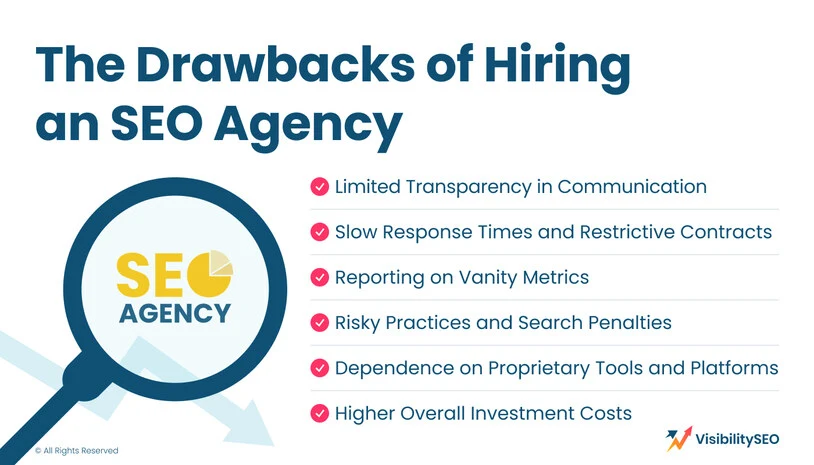
An agency can bring more people, but more people can also mean more distance. You may not speak directly with the SEO specialist doing the work. Instead, you may speak with an account manager who passes messages between teams.
This can still work if communication is clear. It becomes a problem when updates feel vague, slow, or too polished. Before hiring an agency, ask who is working on your account. Ask who owns the strategy, who checks technical SEO, who writes the content, and who reviews results. The answers will tell you a lot.
Limited Transparency in Communication
Communication can become less transparent when several people sit between you and the work. The account manager may be helpful, but they may not be the person making SEO decisions. If they cannot explain the strategy clearly, you may feel disconnected.
A good agency should make the work easy to understand. You do not need to know every technical detail. But you should know what is being done, why it is being done, and how it links to your business goals. If the answer is always vague, that is a warning sign.
Slow Response Times and Restrictive Contracts
Some agencies move slowly because they have set processes and many clients. A simple request may pass through several people before anything changes. That can protect quality, but it can also delay action.
Contracts can make this harder. Long terms, strict notice periods, and unclear cancellation rules can leave a business feeling stuck. Before you hire an agency, ask about response times, contract length, what is included in the retainer, and how problems are handled. These details may seem boring at the start. They matter later.
Reporting on Vanity Metrics
Some reports look good but say very little. Impressions, keyword gains, and traffic charts have value, but they do not prove that SEO is helping the business. A report can show growth and still avoid the harder question: did this create leads, sales, or better business outcomes?
A better report explains the work completed, the results so far, the problems found, and the next actions. It should include traffic and rankings, but also conversions, SEO leads, content updates, technical fixes, and link building where relevant. The report should help you make decisions.
Risky Practices and Search Penalties
Risky SEO can damage a site for a long time. Some agencies still use cheap links, low-quality guest posts, copied content, or thin pages built only around keywords. These methods may create short-term movement, but they can lead to ranking drops and search penalties.
Ask how the agency builds links. Ask who checks content. Ask whether you approve outreach targets. Ask what quality standards they use. A serious agency will not be offended by these questions. If the answers sound too easy, too secretive, or too fast, be careful.
Dependence on Proprietary Tools and Platforms
Agency tools can be useful while the work is active. Dashboards, reports, keyword trackers, and project platforms can make communication easier. But they can also create dependence if everything important lives inside a system you lose access to later.
Your business should keep the important SEO assets. That includes audits, keyword research, content plans, technical notes, reports, and strategy documents. The agency can use its own tools, but the knowledge should not disappear when the contract ends. You should not have to start again from zero.
Higher Overall Investment Costs
An SEO agency usually costs more than a consultant. The higher cost covers the team, tools, content production, project management, reporting, and agency overhead. If you need full-service SEO, that cost may be worth it.
If you only need an SEO audit, a second opinion, or strategic direction, it may not be worth it yet. Look at the total cost and compare it with the work included. Are you paying for useful execution, or are you paying for a larger structure than your business needs right now?
Ready to Work With an SEO Agency?
An SEO agency may be the right fit if your business needs regular execution across technical SEO, SEO content production, link building, digital PR, reporting, and campaign management. It can also be useful when your in-house team is too small to manage SEO properly.
A consultant may be better if you already have people who can implement the work and only need senior guidance. Some businesses use both. The consultant gives oversight and strategic direction. The agency or in-house team handles delivery. That can give you the best of both worlds, but only if the roles are clear.
Before deciding, ask one practical question: what work needs to happen every month, and who will actually do it? The answer usually points to the right SEO partner.
FAQs
Is it cheaper to hire an SEO consultant or an agency?
In most cases, an SEO consultant is the more budget-friendly option. Independent consultants usually have lower operating costs (£300 to £1000), so their monthly fees are often more affordable than agency retainers. Agencies typically charge more (£1500+) because they provide larger teams, broader services, project management, and additional operational support.
Who should hire an SEO agency instead of a consultant?
An SEO agency is usually a better fit for businesses that do not have an in-house marketing team and need fast, scalable support. Agencies can handle multiple areas of SEO at once, including technical audits, content creation, link building, and implementation, making them useful for companies that need a complete done-for-you service.
Is an SEO consultant suitable for large SEO projects?
Yes, an SEO consultant can be a strong choice for larger SEO projects, especially when the work requires expert analysis, strategy, technical guidance, or oversight. However, whether a consultant is the right fit depends on the size of the project, the company’s goals, and the internal resources available to support execution.
How do SEO agencies report progress and results?
SEO agencies typically report progress by connecting SEO activity to business outcomes, such as traffic, leads, and revenue. Reports are often shared monthly or every two weeks and usually include performance metrics, keyword movement, completed tasks, and the impact of ongoing SEO work.

- SEO Consultant vs SEO Agency – What is the Difference? - June 25, 2026
- FAQ Schema: A Simple SEO Trick for Better Visibility - December 20, 2025
- What Is YMYL and Why It Matters for SEO? - December 16, 2025